

Before the rise of Azazil. Before the dominion of the jinn. And long before the creation of Adam (‘alayhi salam), Ard bore witness to a race far more ancient, enigmatic, and forgotten: the Jann.
These were not the jinn as we know them today. They were their progenitors, spoken of only in whispers among tafsir, and occasionally mentioned in Sufi metaphysical traditions.
“And indeed, We created man from clay, from molded mud. And the jann We created before from scorching fire.”
— Surah Al-Hijr (15:26–27)
🌑 Who Were the Jann?
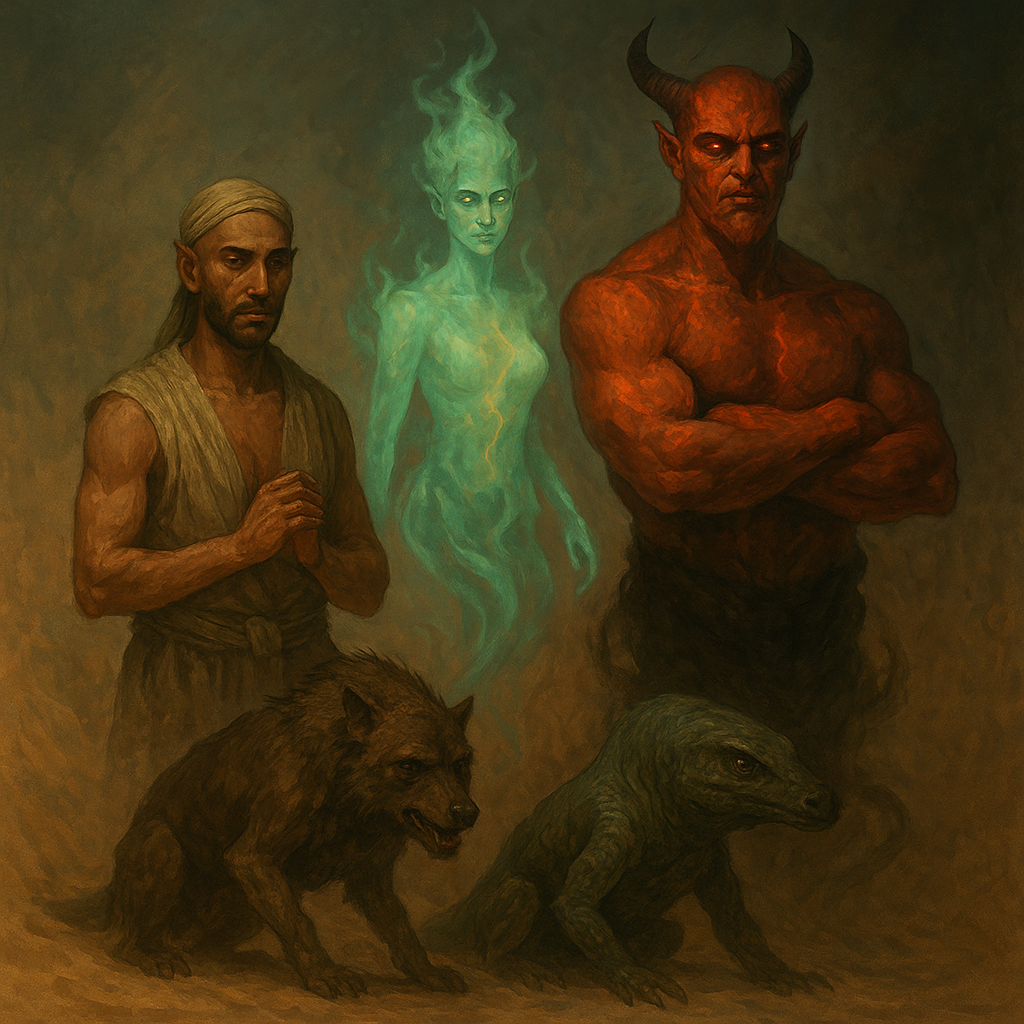
The Jann are described as the first sentient, willful beings to inhabit the Earth. Created from smokeless fire, but of a more raw, elemental, and volatile form than their jinn descendants, the Jann roamed a world untouched by man or divine revelation.
According to early tafsir (including that of Ibn Kathir and al-Tha‘labi), they lived in vast, ancient kingdoms, long lost beneath desert sands and mountain caverns. Their time on Earth is said to have lasted thousands of years before even the rebellion of the jinn began.
🔥 Nature and Traits
- Made of pure, chaotic flame, not yet refined into the more stable marij min nar of jinn.
- Warlike and tribal—prone to sorcery, territorial battles, and fierce pride.
- Possessed early magic and knowledge of Earth’s hidden energies.
🏺 The Rise and Fall of the Jann
The Jann are believed to have caused mass corruption, leading to cosmic imbalance. This prompted Allah to send the angels—led by Azazil, who was still among the jinn at that time—to wage war against them.
- The Jann were either destroyed, driven underground, or banished to realms hidden from mankind.
- The surviving lineage became what we later call jinn—a more evolved, stable version, but with inherited memory of their primal past.
🌀 Legacy and Echoes – Whispers from Nan Madol and the Mountains of Yemen
In mystical traditions, some believe:
- Ruins of the Jann exist beneath ancient mountains and deserts.
- They may have been the first to shape words, use sigils, and manipulate sound-based energy.
- Qareens and shadow entities may sometimes trace their essence to the Jann rather than later jinn tribes.
They are gone—but not forgotten. And perhaps, in the folds of hidden time, they still wait.
One such lingering question surrounds the ancient megalithic site of Nan Madol, a mysterious city built of basalt pillars off the coast of Pohnpei Island in Micronesia. Scholars have long debated how such massive structures could have been placed atop coral reefs without known tools or mortar.
Some esoteric traditions and oral histories propose that the Qareens—shadow companions of great beings—or even remnants of the primal Jann played a role in guiding or moving such megaliths. The unusual geometry of the stones, their magnetic anomalies, and the spiritual eeriness of the place suggest interactions beyond mere human capability.
These entities may have had access to:
- Sound-based levitation or manipulation of vibrational forces,
- Elemental control tied to flame and air,
- Or the ability to dwell in and manipulate the unseen realm in ways that intersected physical creation.
Whether tools of forgotten civilizations or whispers from a pre-human age, structures like Nan Madol stand as silent testimonies to something powerful and largely erased—a buried echo of the Jann and their unseen influence on the early Earth.
In pre-Islamic Arabian lore, Yemen was often described as a gateway into the unseen. Vast caves in Hadramawt, the windswept plateaus of Al-Mahrah, and the fog-veiled mountains of Jabal Qamar were believed to be strongholds or sanctuaries of jinn clans—perhaps remnants of the Jann who retreated into these southern lands.
Poets and soothsayers in ancient Arabia referenced mysterious beings in the deep wadis of Yemen who spoke in rhyme, granted inspiration, or guarded buried secrets. The legendary city of Iram of the Pillars, mentioned in Surah Al-Fajr, is by some accounts associated with Yemen or the southern Arabian desert—possibly built by or for beings not entirely human.
Thus, both Nan Madol in the East and Yemen in the South offer matching echoes—traces of an ancient age when the Earth was shared with the Jann, and where the veil between seen and unseen was thin.
📚 Sources and Inspirations
- Ibn Kathir, Tafsir al-Qur’an al-‘Azim, commentary on Surah Al-Hijr (15:27)
- Tafsir al-Tha‘labi, early discussions on the Jann and pre-Adamic creation
- Al-Qurtubi, references to early inhabitants of Earth
- Sufi cosmology (e.g., Ibn Arabi) – reflections on primal beings and pre-human Earth
- Al-Jahiz (9th-century scholar), in Kitab al-Hayawan, mentions of ancient non-human races
- Surah Al-Hijr (15:26–27), Surah Ar-Rahman (55:15)



























Leave a Reply