
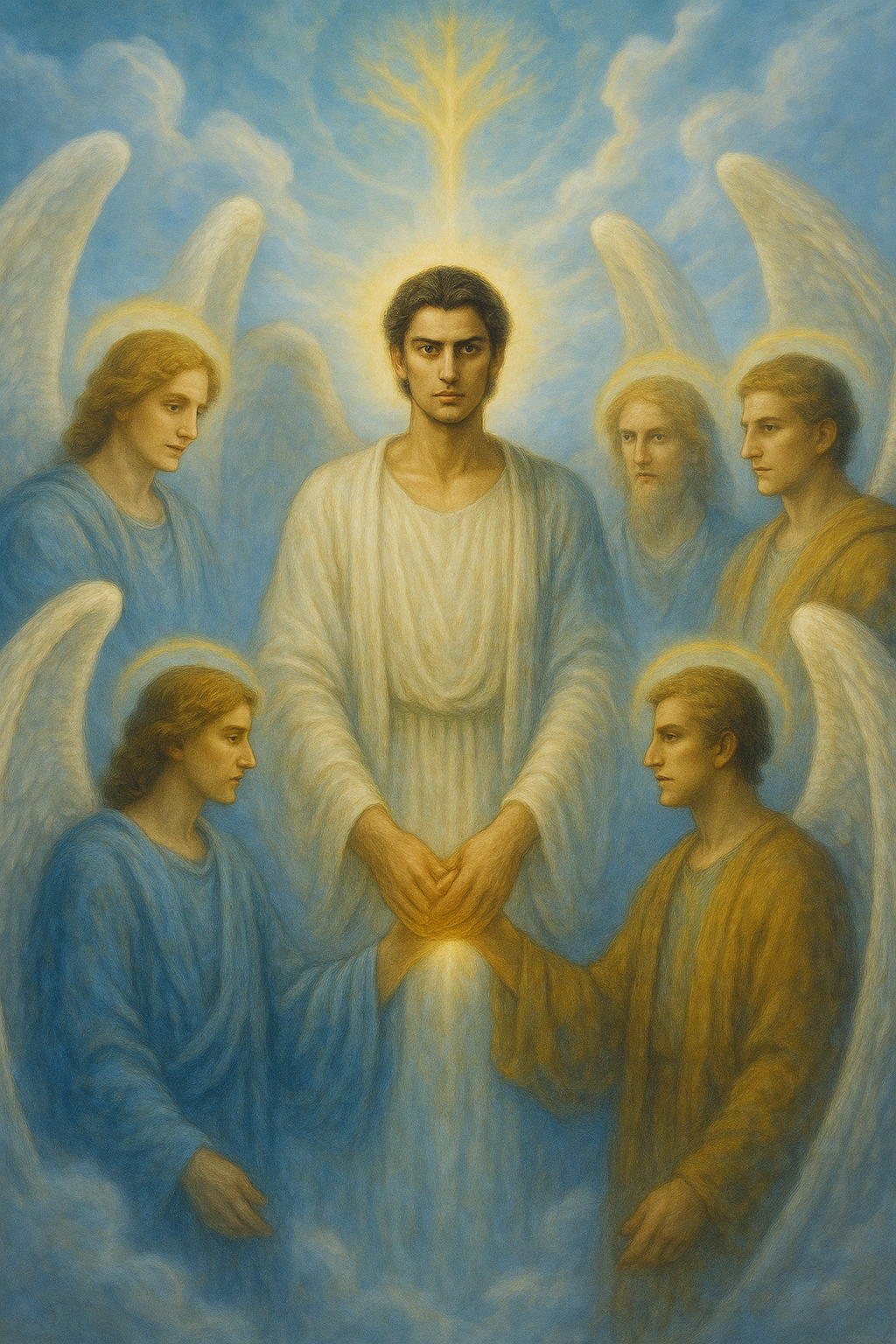
In the vast celestial expanse, Azazil’s presence among the angels was not that of a stranger. Over centuries, he formed deep ties with the four archangels—not through origin, but through shared devotion.
Jibril (‘alayhi salam), the bearer of revelation, is said in early mystical commentaries to have held Azazil in high regard. They stood side by side in worship, their sujood echoing across the heavens. Azazil would often accompany Jibril in descending to the lower realms, bearing messages of divine wisdom to the jinn still clinging to righteousness.
Mikail (‘alayhi salam), guardian of provision and sustenance, was said to have shared discussions with Azazil on balance and justice—how to maintain harmony on Earth.
Israfil (‘alayhi salam), whose breath would one day herald the end, marveled at Azazil’s dedication and sought his insight into the ancient battles against chaos.
Even Azrael (‘alayhi salam), the Angel of Death, was known to respect Azazil’s resolve in upholding divine will, though their duties never directly intersected.
But it was Jibril and Azazil who were the closest.
Their companionship was built on light and law, on knowledge and remembrance. They were seen walking together in the gardens beneath the Sidrat al-Muntaha, reflecting on creation and the mysteries of divine decree.
“We are not of the same essence,” Azazil once said, “but perhaps we are of the same longing—to serve.”
These bonds were not casual—they were forged over millennia, under the gaze of the Throne.
The fall, when it came, would not only break divine law… It would also break hearts.
🔹 Scholarly Sources and Inspirations
- Ibn Kathir, Al-Bidayah wa al-Nihayah, mentions Azazil among the jinn who worshipped Allah extensively, and refers to the descent of angels to fight the jinn before Adam’s creation.
- Sahih Muslim, Book of Faith – Iblis is confirmed as jinn and not of the angels, indicating a distinction in creation but not necessarily in status prior to his fall.
- Tafsir al-Tha’labi, expands on the rank of Azazil before his fall and his years of prostration in every corner of the heavens.
- Wahb ibn Munabbih (as cited in various tafasir) – mentions Azazil’s high station, his devotion, and his participation in celestial affairs alongside angels.
- Sufi metaphysics – Futuhat al-Makkiyyah by Ibn Arabi, where Azazil is viewed as the first monotheist in a paradoxical sense for refusing to bow to other than Allah.
- Tafsir Ruh al-Ma’ani by Al-Alusi, touches on angelic camaraderie and the exceptional standing of Azazil prior to his test.
- Qushayri’s Risalah – symbolic representation of stations (maqamat) of the awliya’, reflected in Azazil’s climb prior to his fall.
- Surah Al-Kahf (18:50), Al-A’raf (7:11-12) – primary Qur’anic anchors for his origin, role, and disobedience.

























Leave a Reply